Sunday, September 13, 2020
Teriyaki beef jerky
Marinated cucumber salad
The grape tomatoes are firm, and allow for a little 'burst' of flavor. They also look great, and add a lot of beautiful color to the dish.
Ingredients:
Salad
1 large cucumber, edges forked, and thinly sliced
10 ounces of grape tomatoes, halved
1/2 red onion, halved, then thinly sliced
1 ripe avocado, diced
3/4 cup crumbled feta cheese
Basil leaves
Dressing
2 ounces olive oil (I use Barouni olive oil from Joelle)
2 ounces white vinegar
1 teaspoon honey
1 tablespoon orange juice
1/2 teaspoon poppy seeds
Directions:
Into a gallon Ziploc storage bag, add all your prepared vegetables.
Add the dressing. Press to remove most of the air from the bag, and toss the bag to coat its contents. Marinate overnight, or at least 12 hours. Turn the bag over a few times as it marinates, to make sure all vegetables in the bag get a nice 'swim' in the marinade. Prior to serving, transfer salad to a decorative bowl, toss, garnish with basil leaves and sprigs, and serve as a side to any grilled meat or other main dish.
Brown Butter Buns...
In our house, the cookie dude is not me. My husband has taken on that role, and has tweaked and massaged his recipes to the point of perfection. This recipe is probably his crowing glory, though his peanut butter cookies are legendary.
For me, baking cookies is like making 3 dozen tiny cakes. I'd rather make one big one, and call it good.
Two ingredients make these cookies the powerhouse they are: browned butter and sea salt flakes.
If you are unfamiliar with how to brown butter, I suggest you take a look on YouTube for a tutorial. I could provide one here, but there are plenty online. The trick with browning butter is to refrain from going too far. It will go from nutty perfection to cremate faster than you can take a breath to say, "oops". The second it reaches your desired level of "brown", you must get it out of the pan you just heated it in, and make sure to use a silicone spatula to get all the browned bits up from the bottom and sides of the pan. If it goes past nutty perfection to cremate, it will smell burned. Don't use burned butter. It will ruin your cookies. Start over. Better to under brown your butter vs. over brown it in this recipe.
I suggest Land O' Lakes butter anytime you need to brown butter. It has less water content than less quality butters, and won't spatter. Both will work, but our best results with this recipe are a direct result of Land O' Lakes.
I also say this with every dessert recipe I share: don't substitute ingredients. It's dessert. It's not meant to be healthy or sugar-free. There are superb sugar-free recipes online. This isn't one that's meant to be sugar-free. *However*, I am always prepared for someone to create a sugar-free version of one of my recipes and prove me wrong. I welcome it! But if you want stellar results, follow the recipe as is.
Once you have your browned butter, it must cool to room temperature, completely. If it's still warmish, let it set until it's completely cool. Once it's completely cool, here's the recipe that will change the way you think chocolate chip cookies should taste. At the recommended size, this recipe makes approximately 5 dozen cookies:
Ingredients:
260 grams all-purpose flour*
1-1/2 teaspoon baking soda
1/2 teaspoon salt
200 grams solidified browned butter, at room temperature (roughly 2-1/4 to 2-1/2 sticks, but weigh it)
300 grams dark brown sugar (light brown works, too, dark just makes for richer flavor)*
1/2 cup granulated sugar
1 egg + 1 egg yolk
2 teaspoons pure vanilla extract
1-1/2 cups semi-sweet morsels
1 cup chopped pecans or walnuts (we use pecans)
Sea salt flakes
*If you are not using nuts, increase flour to 270 grams
Directions:
Preheat oven to 350 degrees.
Combine the flour, baking soda and salt in a small bowl, stir and set aside.
To a stand mixer fitted with the paddle attachment, add browned butter and sugars. Mix on high speed until smooth and creamy - about a minute. Reduce speed to medium, add egg + yolk and vanilla. Mix until just combined. Reduce speed to low and add chocolate chips and nuts and mix until just incorporated.
Roll into 1-1/4" balls, or use a 1 tablespoon scoop, slightly rounded (that's what the cookie dude in this house does), place on a parchment paper lined cookie sheet, and bake until *very* lightly golden around the bottom edges, approximately 11 minutes, but oven temps vary, so watch them.
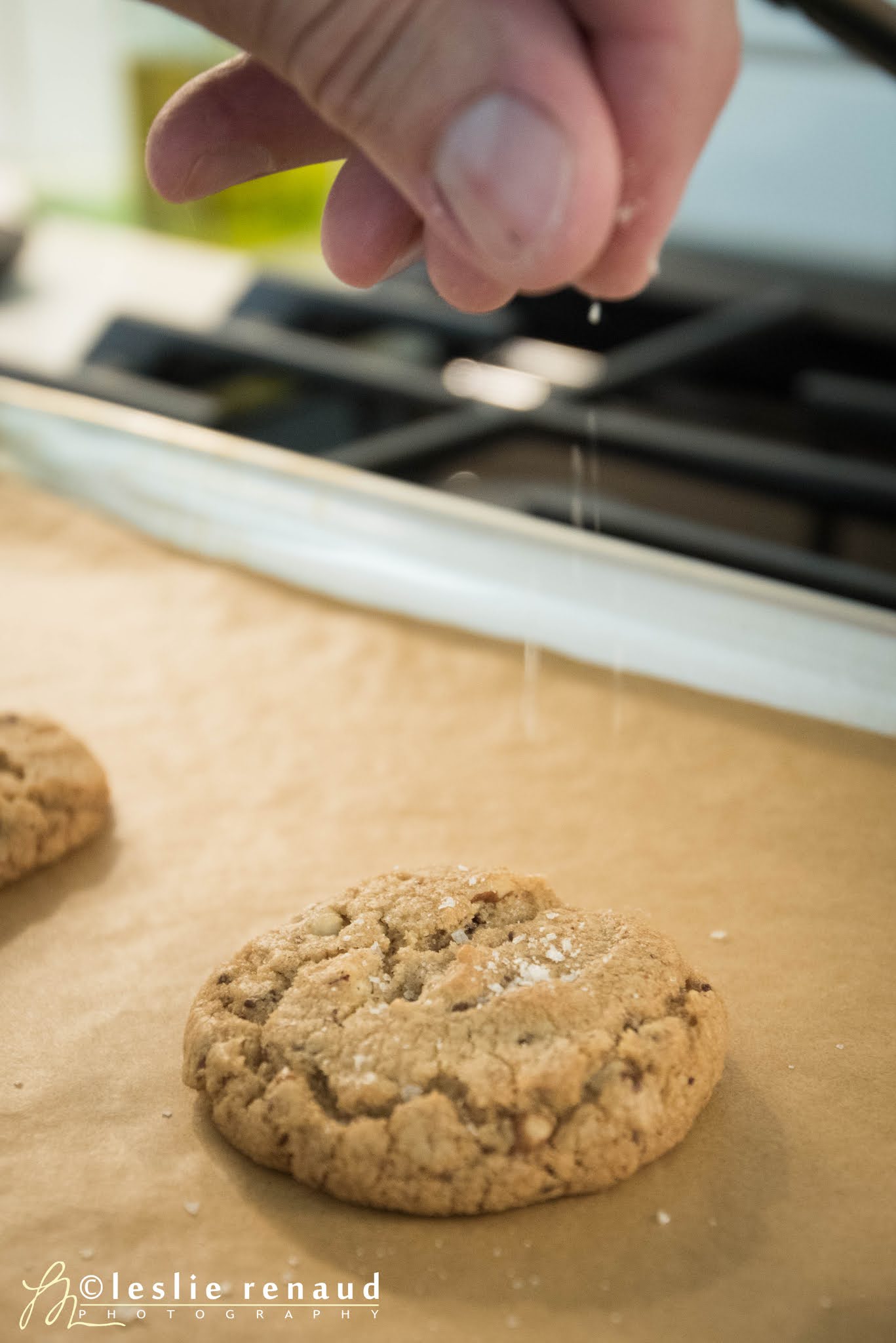
Remove from oven and immediately sprinkle with a few sea salt flakes.
Allow to cool for 2-3 minutes on the cookie sheet, then transfer to a wire rack to cool a bit more. Do yourself a favor, and eat them warm.
The cookie dude recommends scooping all the dough balls onto a parchment paper lined cookie sheet, covering with plastic wrap, and freezing until solid. Once frozen solid, transfer dough balls to a large Ziploc bag, and store in the freezer. When you want cookies, bake just the number of dough balls you will eat fresh from the oven. No more day old cookies! I whole-heartedly concur with his recommendation!
Ollas for the garden - part two
The finished project was pretty straightforward to wrap up. Unfortunately, with fires raging in our state, and other areas of focus, I wasn't great about images for part two, so for that, I apologize.
As I mentioned in part one, the top pot is completely water sealed. I used Rustoleum Ultra Clear water sealant. It worked like a charm.
I used two coats on the inside, and two coats over the paint on the outside, though I added the outside coats over the painted surfaces after I'd adhered the pots together. I left the rim bare of both paint and sealant, because I felt it would create a better seal with the silicone, and it did.
Before adhering the two pots together, the drain hole in the bottom, unglazed pot must be plugged. You can do this several ways, but in my experience, the best option is to tape off the hole from the outside, then add about 1/2" of concrete into the bottom of the pot. I have also used hot glue, which works okay, but I don't think it's a long term solution.
To adhere the two pots together, I smeared a thin layer of silicone on the bare rim of the top pot, making sure to completely cover the entirety of the bare rim. I then ran a bead all around the rim on the bottom pot. I upturned the top pot, and set it on the bottom pot. I then ran another bead around the outside edge, and smoothed it with my finger. I used painter's tape to create an edge, so it wouldn't look sloppy, but this wasn't really necessary.
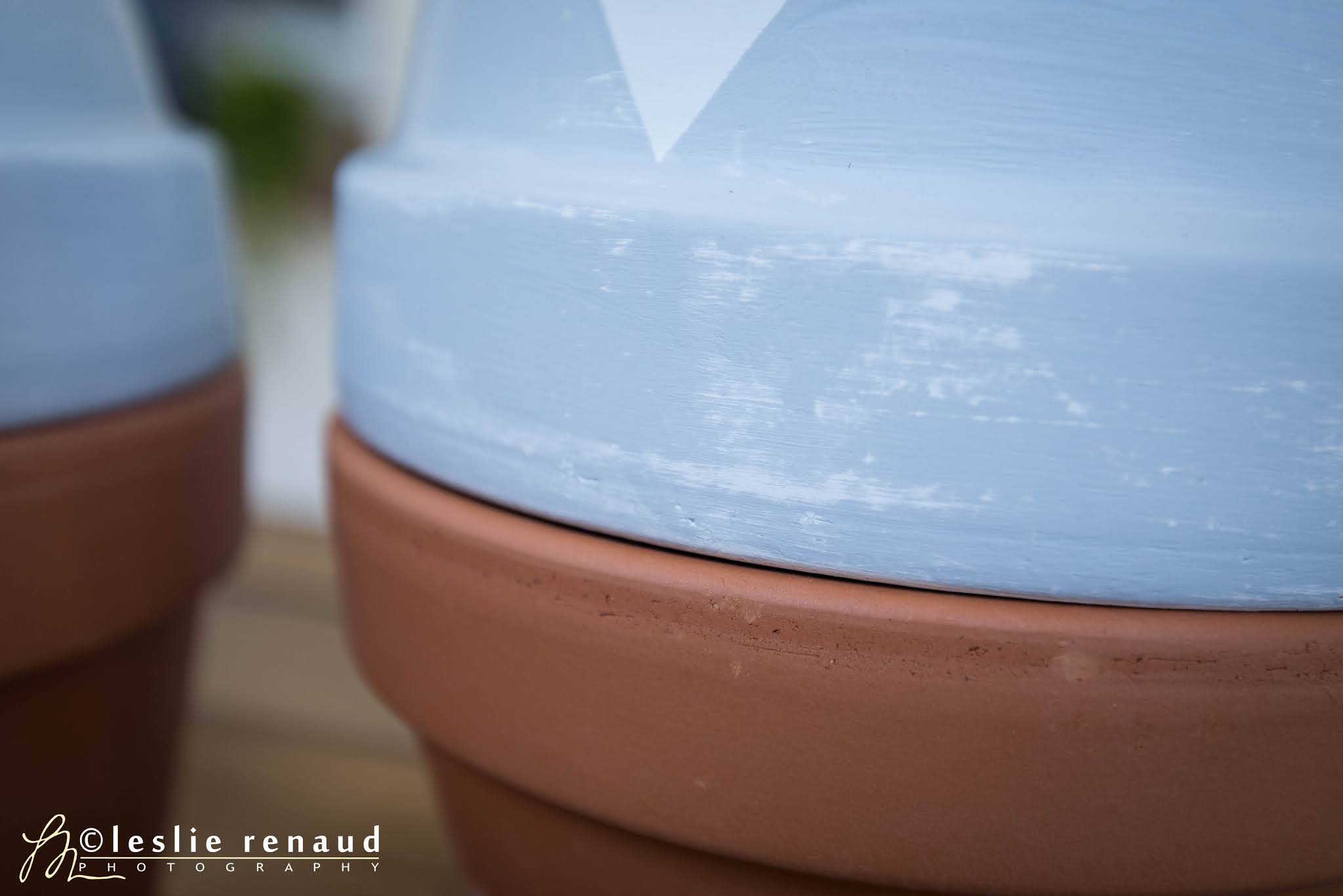
In the images I've included in this post, the top pot hadn't yet been water sealed or adhered to the bottom pot. The two pots are simply dry fit, but this gives you an idea of the finished look.
The entire reason to water seal the top pot is to keep the roots low. I didn't do this on my first and second generation of ollas, and I found the roots were barely below the surface. Unless the olla was topped off all the time, these top residing roots would dry out. This didn't seem to be an issue for my basil, but it was for my tomatoes. Tomatoes are water hogs, and they do not like inconsistent watering. With the roots so high, watering wasn't as consistent.
Adding the water sealed top pot as a reservoir, and burying the ollas with 2-3" of the sealed reservoir under the soil surface, the roots would stay lower, and likely not dry out, as the bottom pot would always (in theory) be full as the water level in the reservoir drains into the bottom, unsealed wicking pot.
For the pots I painted white, I also painted some clay coasters white. Before water sealing the coasters, I stamped them with a custom design. My husband always calls my garden "Shangrila". We live in Bend, Oregon, and the numbers at the bottom are the days of the months in which my beloved dogs were born. Jet 8/23, Ty 7/11 and Kindle 7/5. I love things with meaningful content. Here you can see the lid resting over the "fill" hole for the olla, which is simply the drain hole of the pot...
Wednesday, August 26, 2020
Ollas for the garden - part one
As time has progressed in my gardening journey, I find I am most happy with a closed gardening system, where everything is in a container of some kind, with a subterranean watering process using ollas. Not familiar with olla irrigation? It's essentially an unglazed, porous vessel filled with water, buried underground that releases water into the surrounding soil. They can be purchased, but are extremely expensive. I made mine for about $8, including the paint and sealant.
Here is how Wikipedia describes olla watering action:
"When the soil around the olla is dry, the soil pulls the water through the porous wall of the olla, and into the soil - the tension is between the wet and dry - thus providing water for the roots. When the soil is wet from rain, or has not dried out yet, there is no tension and the water is not pulled through the wall of the olla."
I learned a lot with my first olla design...that's code for "I made a few mistakes". I have endeavored to correct those mistakes in my new design. Before I get into what I learned, here are my first and second generation ollas.
The first generation was super simple. Just a pot set into the soil near the plant, with the saucer used as a lid to reduce evaporation and keep pests away. While it turned out to be too small for the size the tomatoes would eventually reach, it proved to me this was a viable and efficient method of watering. The roots found the water source, and wrapped themselves around it, drawing out the water they needed.
My mistakes were plenty in the first generation ollas, but I do not plan to be defeated, hence the second, and now the third generation designs. I succeeded in growing tomatoes with this irrigation method, even though I started late, so while the mistakes were plenty, the news wasn't all bad.
Now, the mistakes.
The first mistake I made was putting some of my tomatoes in terra-cotta pots. While terra-cotta pots are a great vessel for most plants, they dry out far too fast, and I couldn't keep enough water in the ollas to keep the plants happy. I had to do supplemental watering. It worked, it just meant I had to water more often, and it meant the watering for the roots in the ollas was inconsistent - not my goal, and not the hallmark of an olla.
The second mistake I made was using too small of an olla. Tomatoes are water hogs. My small ollas couldn't keep up, so they suffered from some blossom end rot. Once I started the supplemental watering, things improved dramatically. While this hurt the tomatoes, which needed much more water than my small ollas could provide, my basil was happy as a clam in its planter - this was the second generation design.
In this design, I glued the bottom saucer to the top of the pot, then turned the entire thing upside down to bury it. The drain hole was my water refill port. I used a glass wine cork to plug the hole and keep the pests out. This design was functional and great looking. The glass cork made the whole thing look a little whimsical...maybe a little glam, too.
This olla watered the basil planter sufficiently. It needed no supplemental watering. It lead to the happiest, healthiest and most robust crop of basil I have ever grown - it grew faster than I could use it. The kind of problem I have dreamed about!
My basil planter had another advantage, which helped the yield. Because it was a closed system, with no drain holes in the planter (they aren't needed with ollas), I was able to keep the earwigs from snacking on my basil. I'd read earwigs won't cross vaseline, so I put that to the test. I smeared a 1" ribbon of vaseline around the top outer edge of the basil planter. It worked like a charm. Not even one munch hole from an earwig. Score one for farmer Leslie.
Back to the last of my mistakes...
The third and final mistake I made was not getting the wicking part of the olla far enough underground for my tomatoes, which have deeper roots than the basil. My new design addresses this with a water sealed top that acts as a reservoir for the unglazed bottom, which will put the water not higher than about 4" from the soil surface. This should help quite a bit.
Enter the third generation design.
As you can see, the design is two terra-cotta pots, the top one upside down, sitting atop the bottom pot. The top will be completely water sealed - it will act as a kind of reservoir, funneling water down to the lower pot, as the water level lowers, and I'll refill it through the upturned drain hole, just like I do with the olla in the basil planter.
The wicking action is cool. I filled the unglazed pot just to show you how the water wicks out. The drier the soil, the more water the plant pulls from the olla, so the plant will get just what it needs.
Part two I'll cover the custom decor, sealing of the top pot, how I adhere them together, and how deep I plan to bury these.
Now, next year at this time, I may determine I need to tweak the designs more, but given the success of my basil, and what I learned from my first and second generation designs, I am feeling confident enough to bet my 2021 crops on these. Here's to hope.
Thursday, August 20, 2020
Get in my belly...